India in the Footsteps of the Buddha
With a visit to Nepal, his birthplace
Born in Nepal some 2,500 years ago, the Buddha lived in Bihar, in northeastern India. He attained Enlightenment near Gaya, thereafter known as Bodh Gaya, delivered his first sermon at Sarnath, near Varanasi, and entered Nirvana at Kushinagar, where his funeral rites were performed. These exceptionally inspiring places witnessed the development of one of the most influential schools of thought in Asian history. Remarkable works of art and a rare atmosphere of spirituality still mark them today. Did not the Dalai Lama, only recently, gather hundreds of thousands of followers at Sarnath for the great Kalachakra ceremony? This itinerary invites you on a journey through Buddhist art and philosophy, infused with the Buddha’s message to humanity and with poetic images, both real and legendary: the symbolic pillar at Lumbini, rising beneath a clear sky on a narrow strip of earth and marking, amid infinite space, the birthplace of the sage of the Shakya clan; the fig tree of Enlightenment; the Deer Park of the first sermon; and the thousand-petalled lotus on which the seated Buddha multiplied himself. Profound aesthetic experiences illuminate the journey: the almost divine perfection of a Gupta Buddha with an inward-looking gaze, a jewel of Sarnath Museum; the magnificent stupa at Sanchi; and the sculpted and painted Buddhist caves of Ellora and Ajanta. The itinerary also takes in the great Hindu and Jain sites along the route. Varanasi, the holy city on the Ganges and one of the world’s most moving sacred cities, and the extraordinary monuments of Khajuraho add further highlights to the central theme.

Detailed Itinerary
Day 1 Flight to Delhi.
Day 2 Delhi. Morning arrival. Tour of Old Delhi: the Red Fort, Jama Masjid mosque and Raj Ghat.
Day 3 Delhi. Continue sightseeing in New Delhi: Qutub Minar, Humayun’s Tomb and the National Museum.
Day 4 Delhi / Lucknow / Balrampur. Fly to Lucknow. On arrival, visit the Residency and the large and small Imambaras. Then drive to Balrampur.
Day 5 Balrampur / Shravasti / Gorakhpur. Excursion to Shravasti, the former capital of the kingdom of Kosala and a major centre of Indian Buddhism, where the Buddha stayed on several occasions. Explore the sites of the Jetavana and Purvarama monasteries, as well as Maheth, the original site of Shravasti, where the Buddha multiplied himself while seated on a thousand-petalled lotus. Visit more recent temples. Depart for Gorakhpur, home to the ancient Natha yogi sect with its little-known rites.
Day 6 Gorakhpur / Lumbini / Gorakhpur. A long day by road to Lumbini in Nepal, where the Buddha, Prince Siddhartha Gautama Shakyamuni, was born in 563 BC. Discover the many monuments dedicated to him: the stone pillar erected by Emperor Ashoka in 250 BC; the Maya Devi shrine, said to stand on the very spot where he was born; the foundations of ancient monasteries; and more recent shrines, including a Tibetan Buddhist gompa. Return to Gorakhpur.
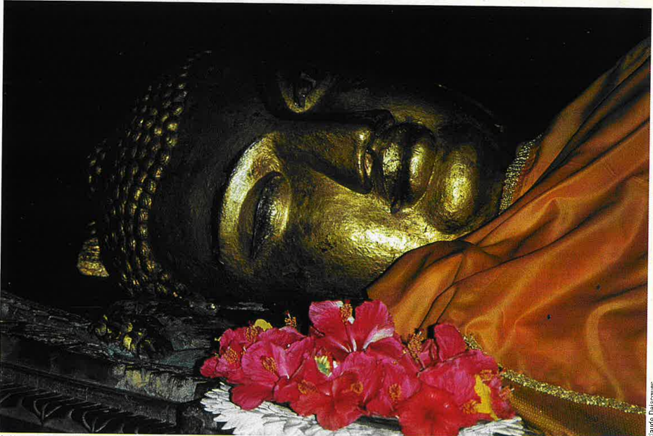
Day 7 Gorakhpur / Kushinagar / Patna. Drive to Kushinagar, the former capital of the Malla kingdom, wherethe Buddha entered Nirvana at the age of 80 and his funeral rites wereperformed around 483 BC. It became one of India’s four great Buddhistpilgrimage sites. Explore the sacred site: the great stupa, Nirvana Temple,foundations of ancient monasteries and a seated Buddha statue depictingEnlightenment beneath the Bodhi tree. Continue to Patna.
Day 8 Patna / Pawapuri / Nalanda / Rajgir / BodhGaya. Depart for Nalanda, home to the Buddhist university from the fifth century onwards, which attracted students from allover Asia. En route, stop at Pawapuri, a Jain sacred site. Explore Nalanda, founded in 467–473 and a centre of the Mahayana, or Great Vehicle, school. Visits include Sarai Mound, monasteries and shrines, and the museum, which houses the bodhisattvas Samanta bhadra and Lokeshvara and other works from Nalanda and Rajgir. Continue towards Bodh Gaya via Rajgir, the city of seven hills, and Gaya, a pilgrimage centre dedicated to Vishnu, with 45 temples. Many pilgrims come here each year for the Shraddha ceremony, described as “final liberation”.
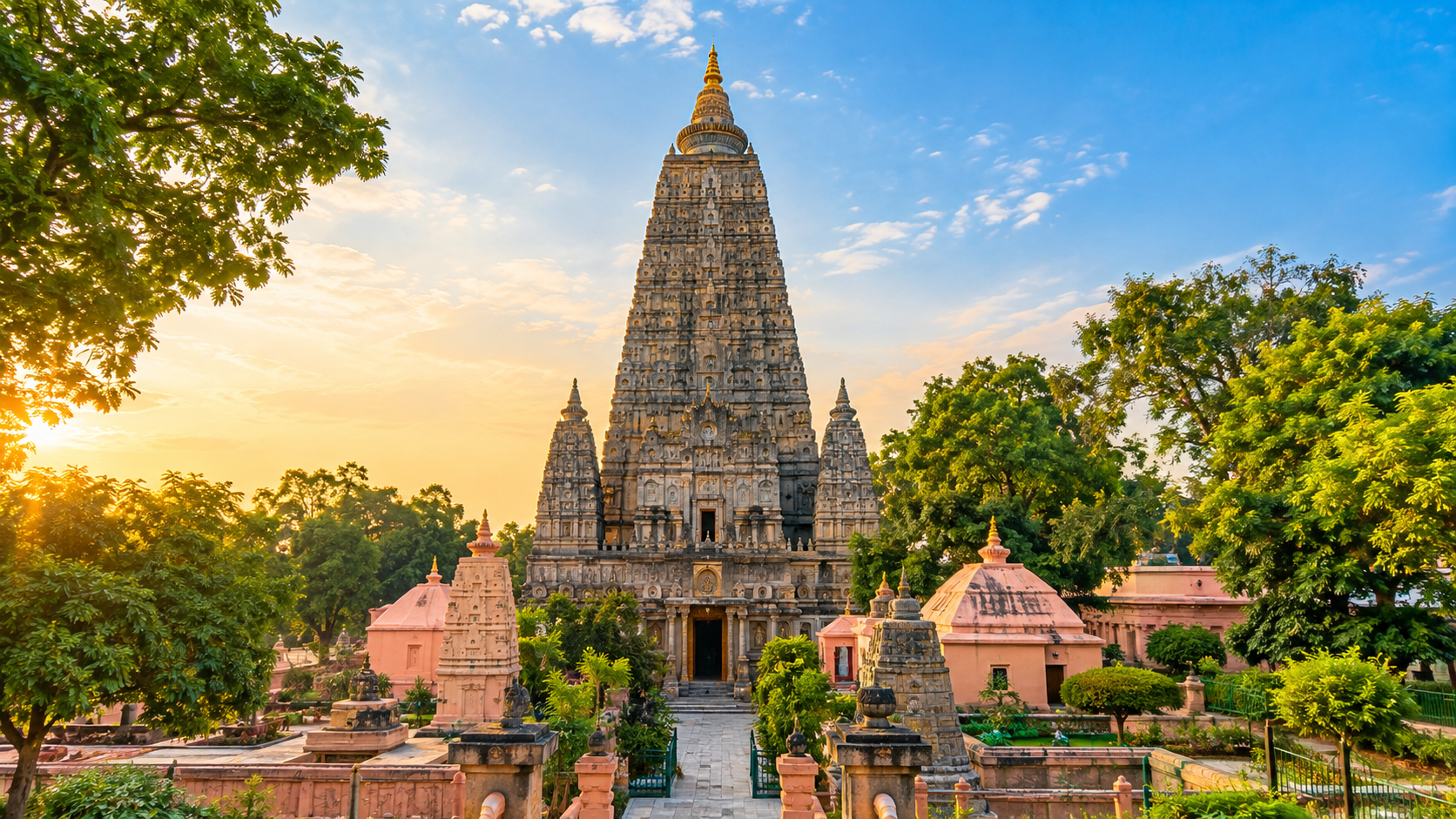
Day 9 Bodh Gaya / Varanasi. Visit Bodh Gaya, another sacred Buddhist site, where Gautama Siddhartha meditated for seven weeks beneath the fig tree, the Tree of Enlightenment, attained wisdom and became the Buddha. This place, devoted to meditation, remains imbued with peace. Explore the Bodhi tree, the Temple of Great Enlightenment (Mahabodhi), a carved stone slab, stupas decorated with scenes from the Buddha’s life, and the museum housing many objects from the Mahabodhi Temple. Depart for Varanasi (Benares), a major Hindu pilgrimage city that was Buddhist in the days of the kingdom of Kashi.
Day 10 Varanasi / Sarnath / Varanasi/ Khajuraho. Early-morning boat ride on the Ganges. Then tour the city: the Golden Temple, Chowk and the ghats. Excursion to Sarnath, where the Buddha delivered his first sermon, the “dharma chakra”, or Wheel of the Law, in the Deer Park. King Ashoka erected several monuments here. Visit the Buddhist temple, the monastery ruins and the museum, whosecollections illustrate the period from the third century BC to the 12th century AD. Return to Varanasi and fly to Khajuraho.
Day 11 Khajuraho. Explore the site of a major capital that flourished in the tenth and eleventh centuries. Some thirty Hindu and Jain temples stand here, renowned for their sculptures: a celebration of the beauty of movement and the human form. Visit the principal temples.
Day 12 Khajuraho / Jhansi / Bhopal. A full day of travel through the landscapes of northern India, by coach to Jhansi and then by train to Bhopal.
Day 13 Bhopal / Sanchi / Udayagiri / Vidisha /Bhopal. Depart for Sanchi, founded in the third century by Emperor Ashoka to house relics of the Buddha. Visit the monasteries, temples and stupas of the archaeological site. The main stupa, a magnificent hemispherical monument, depicts the Buddha’s life on its toranas, or sculpted gateways. Continue to Udayagiri to visit the Jain and Hindu caves, then to Vidisha, an ancient Buddhist city. Return to Bhopal.
Day 14 Bhopal / Bhimbetka / Jalgaon. Excursion to the caves of Bhimbetka. Return to Bhopal. Overnight train to Jalgaon.
Day 15 Jalgaon / Ajanta / Aurangabad. Arrive in Jalgaon and depart for Aurangabad via Ajanta. Visit the sculpted and painted Buddhist caves, which reveal the magnificence of Indian art of the fifth and seventh centuries, notably the Bodhisattva of the Blue Lotus, the Mahajanaka Jataka mural and the Bodhisattva Vajrapani. The first group draws on the Great Vehicle tradition and the second on the Lesser Vehicle.
Day 16 Aurangabad / Ellora / Aurangabad. Excursion to the Ellora caves, a magnificent example of early medieval art. Visit the Buddhist caves, former monasteries in which bodhi sattva figures predominate, followed by the Brahmanical group dedicated to Shiva and the Kailasa Temple, an extraordinary Hindu sanctuary carved from the rock. Return to Aurangabad and visit the Bibi Ka Maqbara mausoleum and the Buddhist caves.
Day 17 Aurangabad / Bombay. Fly to Bombay. City tour: the washermen’s district; Malabar Hill, with its Jain temple and Hanging Gardens; Marine Drive; the Gateway of India; and the Gandhi Museum.
Day 18 Bombay. Weather permitting, excursion to Elephanta Island, a major centre of Shaivite spirituality. Visit the Prince of Wales Museum, followed by free time.
Day 19 Bombay Departure.
Practical Information for India & Nepal
Formalities. Your passport must remain valid for six monthsafter your return date. Visas: we arrange these for you. Please return thecompleted forms sent with your booking confirmation one month before departure,together with your passport and three passport photographs, or two for tourstaking place only in India.
Health. Antimalarial medication is recommended.
Climate. From July to September, the monsoon brings heavy intermittent showers. The southwest coast is the most affected, while the southeast coast has a hot, dry climate. Inland areas, including Delhi, Jaipur and Varanasi, are less affected. Ladakh generally has a dry climate.
Suggested reading. Guidebooks: Fodor, Guide Bleu, Nagel, Marcus pocket guides, Mondial Vilo and Des Cinq Continents. Que sais-je? (PUF):History of India, Geography of India and The Himalayas. Guide Bleu (Hachette):In Nepal. Bibliothèque du Voyageur: The Great Guide to Nepal. Olizane:Kathmandu.
Please note. Local circumstances may require changes to tours in India, and domestic flights may be replaced by rail or road transport.